


The Daughter of Two Worlds: How Kamila Batavia’s Music Becomes a Bridge between Civilizations
Aktualisiert: 2. Mai

Hamburg, 30 November 2025 — An essay on Kamila's bi-culturalism
Kamila Batavia exists in a rare borderland.
Not fully Indonesian nor fully European. Shaped by both, yet claimed by neither.
Born in Jakarta and artistically forged in Europe, her work does not choose one identity over the other. Instead, it holds tension and turns that tension into architecture. Every song becomes a bridge. Every lyric, a negotiation between memory and distance.
Kamila Batavia is, quite literally, the daughter of two worlds.
⸻
Between Indonesia and Europe
Kamila’s songwriting moves through two emotional geographies at once.
From Indonesia, she carries Nusantara softness, a language steeped in imagery, nature, and feeling rather than resolution. Words like senja, pawana, sukma, bahtera appear not as metaphors to be decoded, but as emotional states to be entered.

From Europe, she inherits existential clarity, questions rather than answers, distance rather than drama, reflection rather than catharsis. Her German writing leans into dream logic and philosophical uncertainty, shaped by continental lyricism and inner stillness.
She does not flatten these worlds into something digestible but lets them coexist.
⸻
Three Languages, Three Emotional Registers
Kamila’s artistry is multilingual, not for novelty, but necessity.
• Indonesian becomes the language of emotional depth and ancestral memory.
• German carries existential reflection, precision, and inward gravity.
• English acts as the neutral bridge, a shared space where both worlds can meet without dominance.
Each language unlocks a different emotional frequency. Together, they form a complete system: one that mirrors the diasporic experience of living between cultures rather than arriving at one.
⸻
Songs as Liminal Spaces
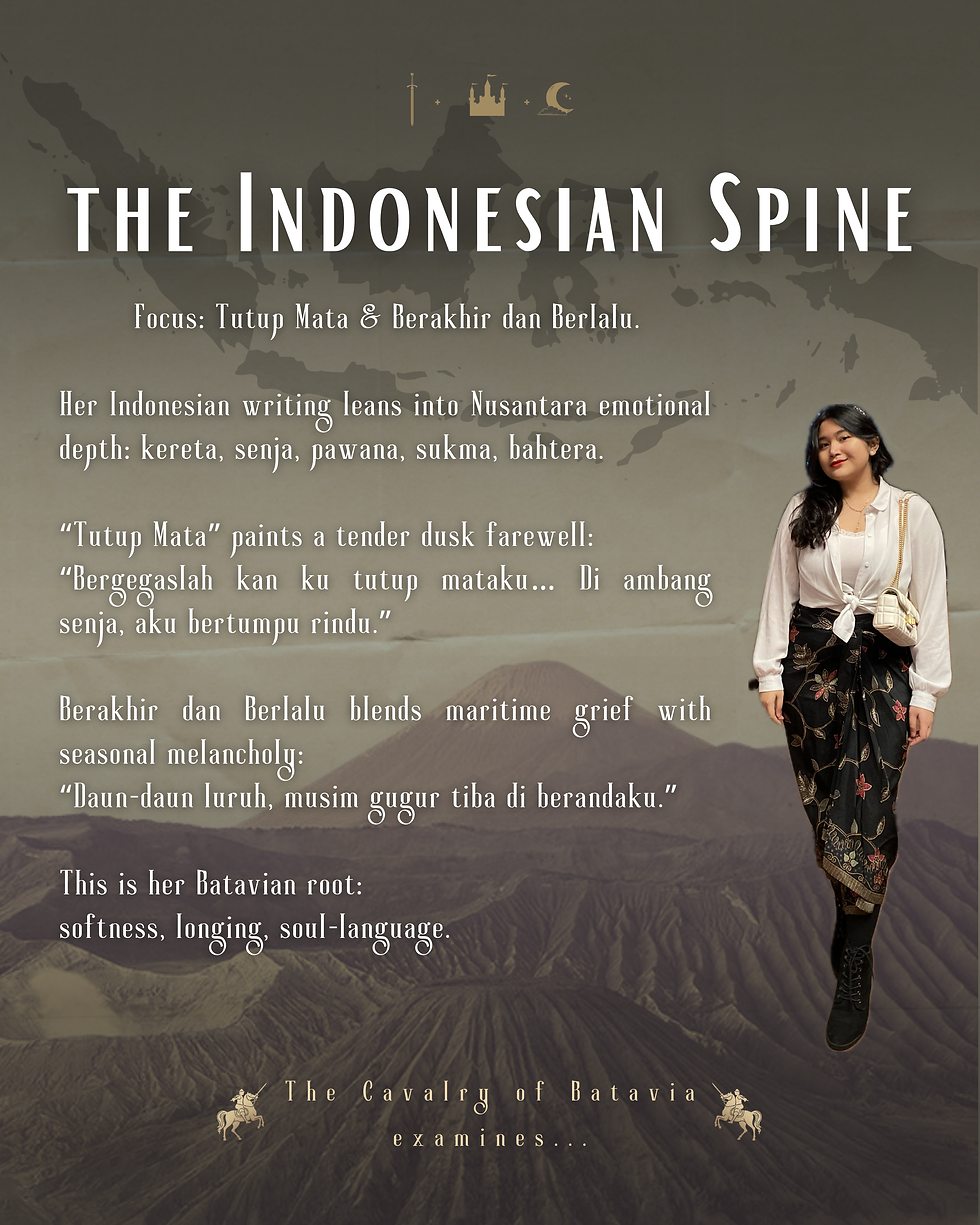
Across her catalog, Kamila writes of:
• dusk train stations
• autumn on foreign balconies
• wild horses without masters
• seas that hold both grief and silence

Her songs often circle a single haunting question:
“Who would search for me if I disappeared?”
This is what's defined as emotional cartography.
Her music does not rush toward hooks or resolution. But it rather lingers, watches, and allows sorrow to exist without spectacle.
⸻
Where Both Worlds Meet

Visually, this duality appears again and again.
In Europe, Kamila often appears with darker tones, embodying the experience of being other.
In Indonesia, her palette softens, carrying the ache of being not enough of home.
She inhabits both and does not correct either perception.
Her imagery, like her music, refuses simplification. Castles rise beside volcanoes. Renaissance silhouettes stand against tropical skies. History and homeland fold into one another.
This visual and sonic language would later crystallize into her self-defined universe: Baroque Galactic, which is a mythic continuation of a life lived between civilizations.

⸻
Not a Split Identity but A Synthesis
Kamila Batavia does not suffer from fragmentation. Here, she practices integration. Her work proves that identity does not have to be chosen, reduced, or explained. It can be built carefully, patiently, and sovereignly. All in all, she connects two cultures as one.
And in doing so, her music becomes a place where listeners, especially those who live between languages, countries, or selves, finally feel seen.


Kommentare